


The Samurai Code: Ancient Principles for Modern Human Performance
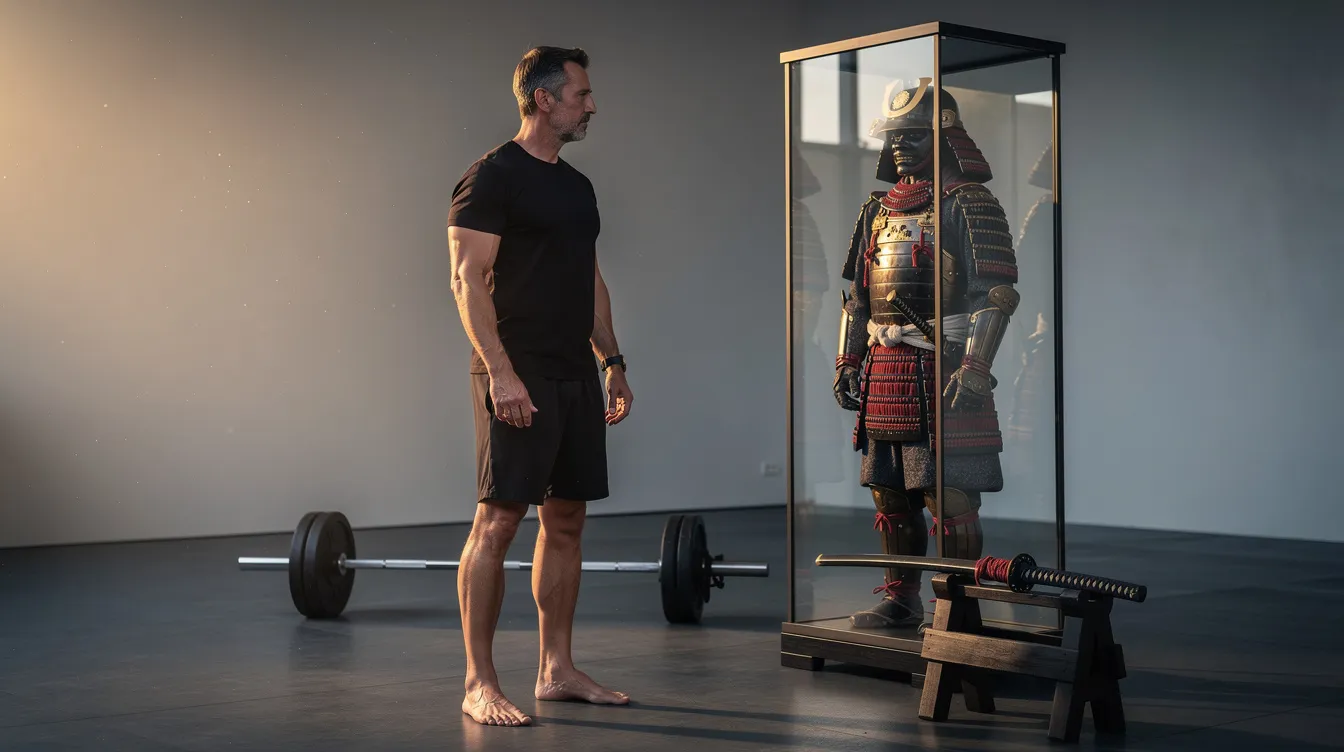
Explore the samurai code as a modern path to disciplined action, integrity, courage, and integrated Human Performance under pressure.
The Samurai Code Is Easy To Admire When Nothing Is At Stake
Integrity sounds noble until telling the truth threatens your reputation. Courage feels natural until the decision could disappoint someone who depends on you. Discipline appears powerful until you realize your routine is keeping you busy but taking you nowhere that matters.
That is where a code becomes real.
It is not proven by what you believe when life is comfortable. It is revealed by what remains available when you are tired, challenged, uncertain, angry, or under pressure.
Many men are physically strong, professionally capable, and relentlessly disciplined. Yet when pressure increases, their behavior is governed less by conscious values and more by habit, fear, obligation, and an identity they have outgrown.
They have principles.
What they do not have is alignment between those principles and the way they actually live.
The modern value of the samurai code is not found in romanticizing warriors, collecting swords, or repeating dramatic quotes about honor. It is found in developing a personal code strong enough to govern your actions when the easiest option is to abandon yourself.
What the Samurai Code Actually Represented
The samurai code is commonly associated with bushidō, translated as “the way of the warrior.” But bushidō was not one universal checklist followed identically by every samurai throughout Japanese history.
Its meaning developed across different periods. According to the Metropolitan Museum of Art, bushidō became more formalized during the relatively peaceful Edo period, emphasizing fidelity, honor, and the combined cultivation of martial and cultural ability.
That last point matters.
The ideal warrior was not defined solely by combat. Samurai culture also valued poetry, calligraphy, philosophy, religious practice, aesthetics, and the arts. The warrior was expected to cultivate both bu—the martial—and bun—the intellectual and cultural.
Strength was not supposed to exist in isolation.
Historical accounts also show that the meaning of bushidō changed as the samurai’s role changed. During prolonged peace, external bravery became less important than internal discipline, moral judgment, duty, and integrity. A historical examination of bushidō describes this movement from battlefield valor toward personal cultivation and ethical conduct.
The code evolved because the conditions changed.
That may be its most important lesson for the modern man.
A Code Is Revealed Under Pressure
Physical training gives you immediate feedback about the code you actually live by.
When the weight becomes heavy, your lungs begin burning, or fatigue starts affecting your technique, you discover whether you can remain present. You learn whether discipline means maintaining intelligent form or merely forcing another repetition to prove your toughness.
Years of martial arts, strength training, hiking, and CrossFit have shown me that discomfort does not automatically build character.
It exposes character.
The body reveals impatience, ego, avoidance, emotional reactivity, and self-deception that the mind can rationalize everywhere else. That is why physical challenge can become a direct path toward mental clarity and identity refinement.
But only if you are willing to pay attention to what the challenge is showing you.
A modern samurai code should help you answer four difficult questions.
Integrity Before Image
Integrity is not simply being honest with other people. It is refusing to create a respectable explanation for something you already know is untrue.
You may call it responsibility when you are afraid to set a boundary. You may call it patience when you are avoiding a necessary confrontation. You may call it discipline when constant activity protects you from deciding what you actually want.
Image asks, “How will this make me look?”
Integrity asks, “What is true, and what does that truth require from me?”
A man without integrity can still appear successful. He simply becomes increasingly divided between the identity he presents and the life he experiences.
That division eventually drains energy, clarity, presence, and performance.
Courage Beyond Endurance

Many high-performing men confuse courage with the ability to tolerate more.
They carry the pressure. Push through exhaustion. Remain composed. Keep producing. Because they can endure the weight, they assume enduring it must be the right decision.
But courage is not measured only by what you can withstand.
Sometimes courage means admitting the mission has changed. It means asking for support before everything starts breaking. It means having a conversation that could alter a relationship, stepping away from an identity that once earned respect, or acknowledging that your success no longer feels meaningful.
Endurance allows you to remain inside a difficult situation.
Courage determines whether that situation still deserves your strength.
Discipline in Service of Direction
Discipline is a weapon. It does not decide where it should be pointed.
A man can be intensely disciplined while pursuing an outdated goal, protecting an unhealthy role, or maintaining a life he no longer wants. He can optimize his schedule, improve his routine, and increase his output while moving farther from himself.
This is misaligned discipline: strong effort applied in the wrong direction.
The samurai code was concerned with duty, but a modern warrior must examine what his duty is serving. Loyalty to a mission that violates your values is not honor. It is self-abandonment dressed as commitment.
Real discipline begins with orientation.
Before asking how to become more consistent, ask whether your consistency is building the man and the life you intend to create.
Self-Mastery Without Emotional Shutdown
Self-mastery is not the absence of emotion.
It is the ability to remain aware of what you are experiencing without allowing every reaction to control your behavior. That requires more strength than shutting down, becoming distant, or pretending nothing affects you.
Emotional disconnection can look like composure from the outside. Internally, it reduces your ability to read yourself, understand other people, recognize changing conditions, and respond intelligently.
A capable warrior does not ignore information because it is uncomfortable.
He uses it.
Fear can reveal what matters. Anger can expose a violated boundary. Frustration can identify misalignment. Exhaustion can signal that the current method is no longer sustainable.
Mastery means receiving the message without surrendering command.
The Samurai Code and Integrated Human Performance

Modern Human Performance is not built through physical strength alone.
Your identity, thinking, emotional regulation, behavior, physical capacity, relationships, and environment operate as one connected system. When one area remains chronically misaligned, the others eventually compensate for it.
You train harder to manage frustration. You work longer to avoid uncertainty. You become more controlling because your direction feels unclear. You withdraw emotionally to preserve the appearance of strength.
Performance may remain intact for a while, but maintaining it begins to cost more.
That accumulating cost is Performance Debt.
An integrated man still has ambition, standards, discipline, and physical strength. The difference is that those qualities are supported by clarity, recovery, emotional presence, adaptability, and conscious purpose.
His code does not merely help him tolerate pressure.
It helps him remain himself inside it.
When Your Code Becomes Armor
A personal code should create direction. It should not become a prison.
Honor without reflection becomes pride. Loyalty without discernment becomes submission. Discipline without recovery becomes self-punishment. Courage without judgment becomes recklessness. Emotional control without awareness becomes disconnection.
This is where many men get trapped.
They continue defending an old definition of strength because changing it feels like weakness. In reality, refusing to adapt may be the least disciplined choice available.
The samurai code evolved as the role of the warrior evolved. Your code must also mature as your responsibilities, body, relationships, values, and season of life change.
You do not need to lower your standards.
You need standards capable of carrying you forward.
Write a Code Your Life Can Prove
A useful personal code does not need to sound ancient or impressive. It needs to be specific enough to guide behavior when pressure begins making decisions for you.
It might include commitments such as:
- I tell myself the truth before circumstances force me to face it.
- I direct my discipline toward purpose rather than using activity to avoid uncertainty.
- I train my body without ignoring the information it gives me.
- I remain emotionally present instead of confusing disconnection with control.
- I adapt my methods without abandoning my values.
The words matter less than the evidence.
Your calendar, relationships, training, boundaries, recovery, and decisions reveal the code you currently live by. If those areas contradict what you claim to value, the problem is not a lack of information.
It is a lack of integration.
The samurai code is not valuable because it belonged to ancient warriors. It is valuable because it confronts the modern man with a question he cannot answer through words alone:
Does the way you live prove what you say you stand for?
If the honest answer is no, do not turn that recognition into another idea you admire and then ignore.
Schedule a Power Strategy Session.
This session is for the physically strong, disciplined man who is still producing but knows something in his life has become misaligned. We will identify where your values and behavior have separated, what that gap is costing your performance and capacity, and what must change for your strength to move you forward again.
This is not a casual motivational conversation. It is a direct examination of the code you are living, the pattern keeping it in place, and whether you are prepared to make your actions match the man you claim to be.
Stop admiring the way of the warrior from a distance. Schedule the Power Strategy Session and begin living a code your life can prove.
Frequently Asked Questions
What is the samurai code?
The samurai code usually refers to bushidō, or “the way of the warrior.” It developed as a collection of ideals concerning duty, courage, integrity, honor, self-discipline, and conduct. It was not one fixed document followed identically by all samurai. Its meaning changed across historical periods as samurai moved from battlefield roles into positions involving government, administration, public responsibility, and personal cultivation.
Is bushidō a fixed list of seven virtues?
No. The familiar list of seven virtues is a useful modern summary, but it should not be mistaken for a single historical code universally practiced by every samurai. Different schools, writers, clans, and periods emphasized different qualities. Bushidō became increasingly formalized and idealized over time, especially during the Edo and Meiji periods. Its history is more complex than the simplified version frequently presented in popular culture.
How can a modern man practice the samurai code?
A modern man can practice the samurai code by defining clear values and making them visible through behavior. This means telling the truth when deception would be easier, choosing direction before applying greater discipline, maintaining emotional awareness under pressure, honoring commitments without abandoning discernment, and training the body as a way to strengthen presence and self-command. The objective is not to imitate a historical warrior but to develop lived integrity.
What does the samurai code teach about discipline?
The samurai code frames discipline as self-command in service of duty and principle. Modern discipline should function similarly, but it must remain consciously aligned. More effort is not automatically better. Discipline becomes destructive when it supports an outdated identity, protects avoidance, ignores recovery, or forces a man to continue in the wrong direction. Effective discipline connects consistent action with values, purpose, adaptability, and the demands of the present season.
How does physical training support Human Performance?
Physical training places the mind and body under controlled stress, making internal patterns easier to recognize. Fatigue can expose impatience, ego, avoidance, poor emotional regulation, and the tendency to sacrifice technique for short-term achievement. When approached consciously, training develops more than strength or endurance. It becomes a practice for improving attention, self-regulation, decision-making, recovery, adaptability, and the ability to maintain aligned behavior under pressure.
