


Living Bushido: Self-Mastery For The Modern Man

Living Bushido turns timeless samurai principles into daily standards for self-mastery, leadership, vitality, relationships, and legacy.
Living Bushido in Modern Life: From Samurai Values to Daily Action
A man can admire the samurai code and still live without a code of his own.
He can train hard, work long hours, provide for his family, and talk about honor, discipline, and loyalty. Yet when pressure rises, he may still avoid the difficult conversation, compromise a standard, neglect his body, or keep pursuing a version of success that no longer fits the man he wants to become.
That is the difference between studying Bushido and living Bushido.
One gives you ideas. The other gives your life direction.
Living Bushido is not about pretending to be a samurai, collecting swords, or borrowing the appearance of another culture. It is about choosing a personal code strong enough to govern your behavior when convenience, fear, ego, and fatigue all argue for an easier choice.
For a modern man, that code becomes visible in ordinary places: the gym, the boardroom, the kitchen, the marriage, the calendar, and the promises nobody else knows he made.
Bushido Was a Way of Life, Not a Motivational Slogan

Bushido is commonly translated as “the way of the warrior.” It did not appear throughout Japanese history as one perfectly uniform rulebook. Samurai ideals changed across eras, clans, and social conditions. The modern virtues often associated with Bushido—rectitude, courage, benevolence, respect, sincerity, honor, and loyalty—were famously organized for a Western audience by Inazo Nitobe in Bushido: The Soul of Japan.
The useful point is not that every samurai followed an identical list. They did not. The useful point is that a warrior’s conduct was expected to reflect something larger than appetite, mood, or immediate comfort.
Modern life gives men endless goals but very few governing principles. Earn more. Build more. Buy more. Perform more. Optimize everything. The problem is not ambition. The problem is ambition without an internal compass.
Without a code, a man can become highly effective at building a life he does not respect.
Living Bushido restores the missing question: What kind of man must I be while pursuing what I want?
Living Bushido Begins Where Motivation Ends
Motivation is useful, but it is unreliable. It rises when progress is visible and disappears when the work becomes repetitive, uncomfortable, or inconvenient.
A code does not care whether you feel inspired.
If physical vitality matters, you train and recover according to the needs of your current body—not the ego of the man you were twenty years ago. If your marriage matters, you give it attention before distance becomes a crisis. If leadership matters, you make the clean decision even when the popular decision would protect your image. If legacy matters, you stop postponing the example you want your children, clients, or younger colleagues to remember.
This is why living Bushido is more demanding than admiring Bushido. Admiration costs nothing. Embodiment requires repeated choices.
The modern warrior is not defined by the intensity of one heroic act. He is defined by the consistency of his standards across hundreds of ordinary moments.
The Body Exposes the Code You Actually Live By
Physical challenge is one of the clearest places to discover whether your code is real.
Under a heavy bar, halfway up a mountain, or deep into a hard conditioning session, performance strips away presentation. You meet your breathing, your preparation, your self-talk, your impatience, and your impulse to quit—or to push recklessly just to prove something.
Training reveals whether your discipline is intelligent or theatrical.
Do you respect technique when nobody is watching? Do you recover with the same seriousness you bring to effort? Can you adapt when age, injury, or current capacity demands a different method? Can you stay composed without becoming disconnected from what your body is reporting?
This is the physical-to-mental bridge at the heart of living Bushido. The body provides honest feedback. The mind interprets it. Identity determines what you do next.
A difficult workout is not automatically a character-building experience. It becomes one when you use the pressure to recognize a pattern, make a more deliberate choice, and carry that standard into the rest of your life.
The man who practices patience under load can practice it with his family. The man who stops lying to himself about recovery can stop lying to himself about work. The man who learns to adjust without surrendering can enter a new season of life without becoming smaller.
A Personal Code Must Survive Real Life

Any value sounds impressive when it remains a word. The test is whether it changes behavior.
Rectitude means making the right decision before calculating how it will make you look. Courage means addressing what matters while fear is still present. Benevolence means using strength to serve, protect, teach, and elevate—not merely dominate. Respect means controlling your conduct when another person is difficult. Sincerity means closing the distance between what you say and what you repeatedly do. Honor means maintaining an internal standard even when there is no external reward. Loyalty means remaining faithful to worthy people and principles without becoming blindly attached to an outdated role, method, or identity.
Living Bushido does not require perfection in these virtues. It requires honesty about where your behavior contradicts them.
That contradiction is where the work begins.
Perhaps you say health is a priority while treating sleep and recovery as expendable. You say family comes first, but your best attention is permanently reserved for work. You say integrity matters, yet you keep postponing a necessary decision because the consequences are uncomfortable. You say you want a meaningful next chapter, but your calendar is still controlled by the expectations of the last one.
A code that never confronts your schedule, habits, boundaries, and decisions is decoration.
Leadership Is Character Made Visible Under Pressure
Many men want greater authority, autonomy, or professional impact. Those are legitimate ambitions. But the higher a man rises, the more expensive his unexamined patterns become.
Leadership magnifies character.
Living Bushido in leadership means telling the truth early, especially when delay would be easier. It means making decisions from principle instead of insecurity. It means taking responsibility without turning responsibility into martyrdom. It means expecting a high standard while refusing to use pressure as an excuse for careless behavior.
The Bushido-inspired leader is not passive or endlessly agreeable. He can be decisive, demanding, and direct. The difference is that his strength is governed. His ego does not get to disguise itself as authority.
This kind of leadership creates trust because people know where the man stands. His words and actions match. He does not become one person when results are good and another when pressure hits.
That consistency is not just a leadership technique. It is identity made visible.
Vitality Is the Capacity to Keep Answering the Call
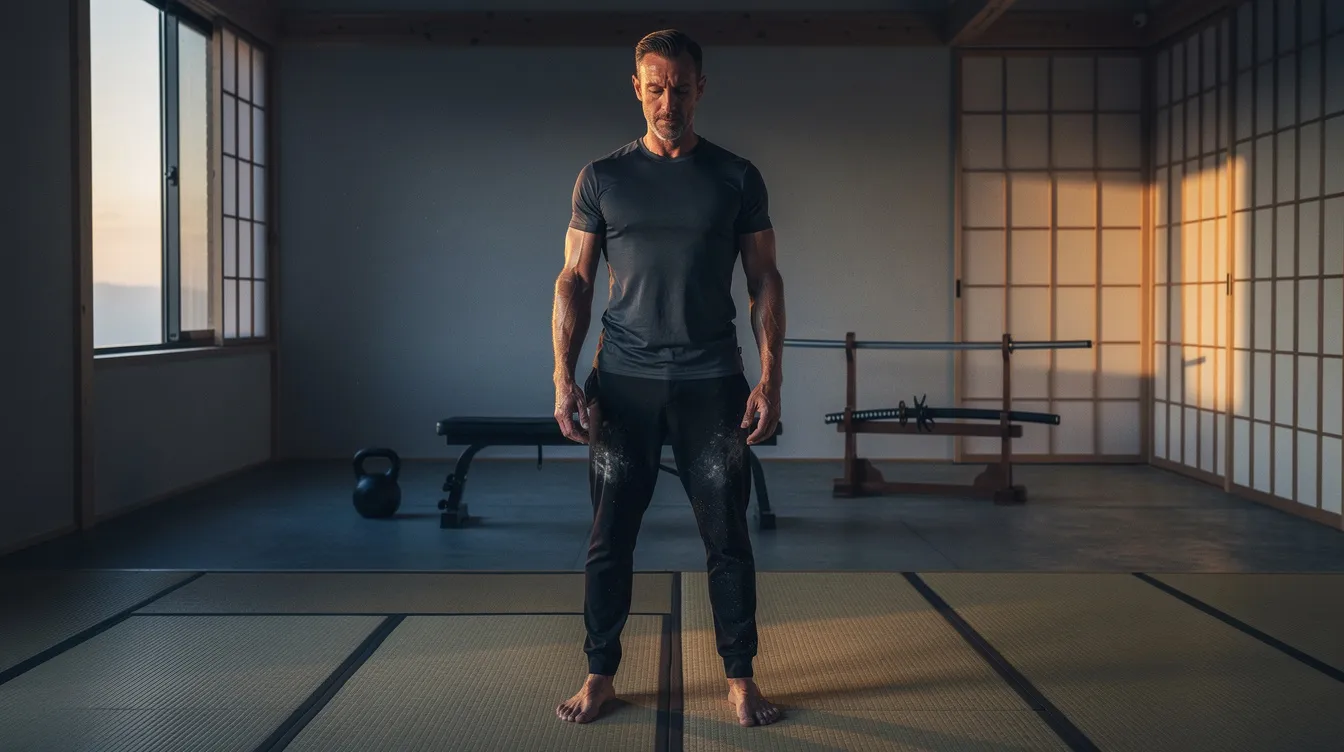
Living Bushido also changes how a man approaches his body as he gets older.
The goal is not to preserve a younger identity through increasingly reckless effort. The goal is to build strength that remains usable—for work, adventure, relationships, service, and the years still ahead.
That requires discipline, but it also requires adaptation. The workout that proved something at 35 may become the workout that steals capacity at 55. Recovery is not retreat. Mobility is not weakness. Changing the method is not abandoning the mission.
Vitality gives a man options. It allows him to hike with his family, remain sharp during demanding work, travel without feeling physically diminished, and enter later life with capability rather than fear. Training becomes more than body maintenance. It becomes preparation for participation.
The code is simple: care for the body that carries your purpose.
Relationships Reveal Whether Strength Has Become Isolation
A man can be dependable and still be unavailable.
He can solve problems, provide resources, and handle emergencies while giving the people closest to him very little access to his attention, honesty, or inner life. He may call this strength because he is not creating conflict. In reality, he may be using composure to avoid connection.
Living Bushido in relationships brings respect, courage, benevolence, and sincerity into the same room. It asks a man to listen without preparing his defense, speak before resentment hardens, and remain present when a conversation cannot be solved in five minutes.
This does not weaken him. It makes his strength more complete.
Loyalty is not merely staying. It is continuing to invest attention, truth, effort, and care in the relationships a man claims matter most.
Legacy Is Built Through Repeated Evidence
Most men do not create a legacy through one grand achievement. They create it through the pattern other people experience over time.
Your children learn what strength means by watching how you handle frustration. Younger professionals learn leadership by watching what you tolerate and what you protect. Friends learn whether brotherhood matters by noticing whether you show up only when it is convenient. Your future self inherits the physical, financial, relational, and spiritual consequences of what you repeatedly practice now.
Living Bushido turns legacy from a distant idea into a present-tense responsibility.
The question is not simply, “What will I leave behind?”
The sharper question is, “What am I teaching people to expect from a man through the way I live today?”
How to Practice Living Bushido Every Day
You do not need a complicated morning ritual or a framed list of Japanese virtues. You need a code that can survive contact with your actual life.
Start with three standards:
- One standard for your body. Define the minimum practice that protects your vitality during a difficult week. This may include training, walking, sleep, recovery, or nutrition. Make it realistic enough to survive pressure and meaningful enough to preserve identity.
- One standard for your conduct. Decide how you will behave when challenged. This might mean telling the truth sooner, refusing gossip, keeping your word, listening before reacting, or making the decision you have been avoiding.
- One standard for your purpose. Protect consistent action toward the future you claim matters. Your calendar should contain evidence of the man you are becoming—not only obligations inherited from the man you have been.
Then conduct a brief evening review:
- Where did I live my code today?
- Where did comfort, ego, fear, or distraction make the decision for me?
- What will I correct tomorrow through action?
Do not turn the review into self-punishment. The purpose is awareness, realignment, and evidence. Honor is not pretending you never miss the standard. Honor is refusing to hide from the miss.
From Samurai Principle to Integrated Self-Mastery
Self-mastery is not controlling every circumstance or suppressing every emotion. It is developing the capacity to act from chosen principles across the full range of your life.
Your thinking, emotions, habits, body, environment, relationships, and purpose all influence one another. When one area repeatedly contradicts the others, strength becomes fragmented. You may still perform, but more energy is spent fighting yourself.
Living Bushido is a way of restoring alignment. Your body supports your mission. Your decisions reflect your values. Your relationships receive more than what is left over. Your ambition serves a meaningful direction. Your daily actions create proof of the identity you claim.
This is integrated self-mastery: not strength in one isolated arena, but strength that remains available wherever life asks for it.
You do not need armor, a title, or a perfect record.
You need a code—and the courage to make your life provide the evidence.
The Resilient Man Framework is designed to help you move from principles you respect to standards you consistently live. Download the framework to examine the mental, physical, emotional, behavioral, environmental, and identity foundations supporting the man you are becoming. Living Bushido is not about admiring an ancient path. It is about building the strength, clarity, and alignment to walk your own.
Frequently Asked Questions About Living Bushido
What does living Bushido mean for a modern man?
Living Bushido means using a clear personal code to guide decisions, habits, relationships, leadership, and physical discipline. It is not historical reenactment or an attempt to imitate samurai culture. It is the modern application of enduring warrior principles such as courage, integrity, respect, service, honor, sincerity, and loyalty. The standard becomes meaningful when it governs behavior under pressure—especially when fear, ego, fatigue, or convenience makes compromise attractive. In practical terms, it means your values become observable through what you repeatedly do.
Is Bushido one fixed historical code?
No. Bushido developed across different periods of Japanese history and was interpreted differently among clans, writers, and social conditions. It was not one universal checklist followed identically by every samurai. The familiar modern presentation of virtues such as rectitude, courage, benevolence, politeness, sincerity, honor, and loyalty was strongly influenced by Inazo Nitobe’s 1899 book, Bushido: The Soul of Japan. A responsible modern application respects that complexity while using the principles as prompts for character, discipline, and self-examination.
How is living Bushido different from ordinary discipline?
Discipline helps you follow through. Living Bushido determines what deserves your discipline and the character you bring to it. A man can be highly disciplined while pursuing an outdated goal, neglecting important relationships, or damaging his capacity through constant pressure. A personal code adds direction to effort. It connects discipline with integrity, courage, service, respect, and purpose. The question changes from “Can I force myself to do this?” to “Does this action reflect the man I have chosen to become?”
Does living Bushido require martial-arts training?
No. Martial arts can provide an excellent environment for practicing attention, restraint, courage, respect, and composure, but they are not required. Strength training, hiking, endurance work, CrossFit, and other forms of physical challenge can create the same honest encounter with discomfort and choice. The important part is using physical stress as feedback. Notice how you respond, identify the pattern, and deliberately carry the lesson into work, relationships, and daily conduct. The training ground is useful because it makes your habits difficult to hide.
Does Bushido encourage emotional suppression?
A shallow interpretation can confuse composure with emotional shutdown, but integrated self-mastery requires awareness—not numbness. A man cannot govern a reaction he refuses to recognize. Living Bushido means noticing fear, anger, disappointment, or insecurity without allowing the emotion to make every decision. It also requires the courage and sincerity to communicate honestly when a relationship or responsibility calls for it. Emotional stability is not the absence of feeling. It is the ability to remain present, choose your response, and act according to your values.
How can I begin living Bushido today?
Choose three standards: one for your body, one for your conduct, and one for your purpose. Make each standard specific enough to observe and realistic enough to maintain during a demanding week. At the end of the day, review where you honored the code, where you compromised it, and what action will correct the gap tomorrow. Do not wait to create a perfect philosophy. Begin producing evidence. A personal code becomes real through repetition, honest review, and deliberate recommitment after you miss the mark.
