


Performance Debt: The Hidden Cost of Still Performing
Performance debt builds while you are still succeeding. Learn how hidden costs erode your clarity, recovery, relationships, and future capacity.
Performance Debt: Why Success Can Hide the Warning Signs
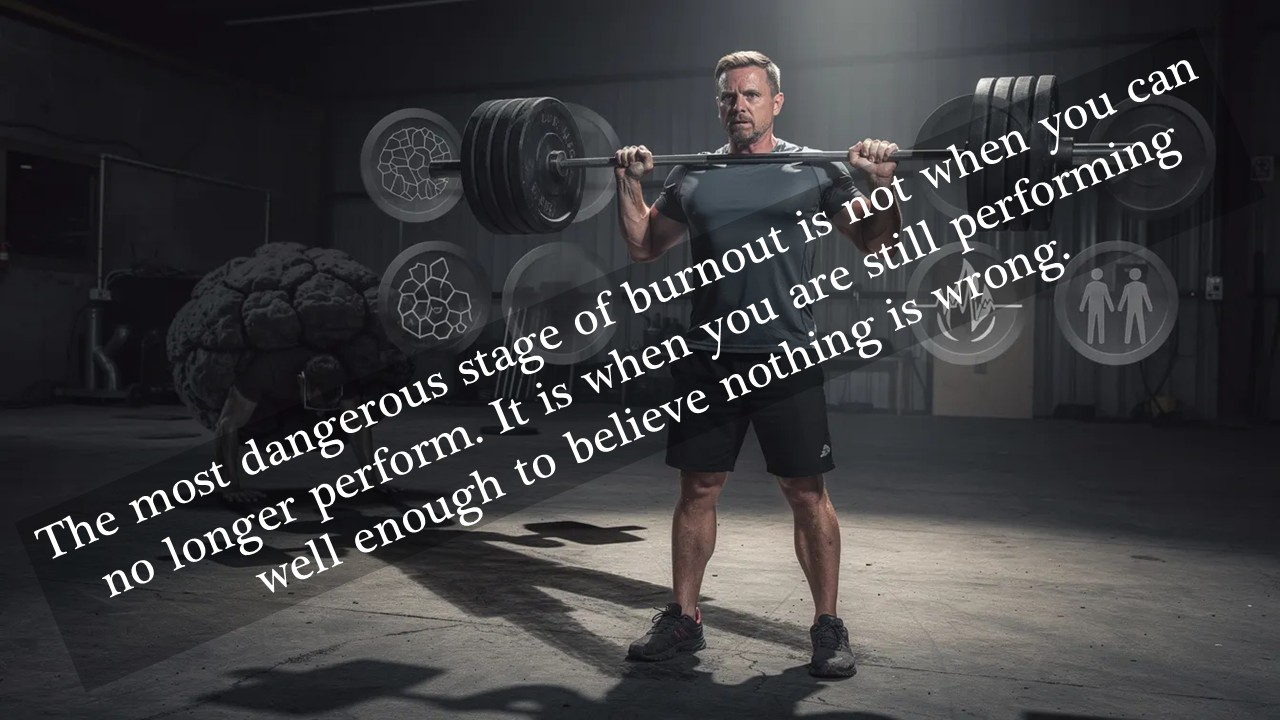
The most dangerous stage of burnout is not when you can no longer perform. It is when you are still performing well enough to believe nothing is wrong.
You are still working. Still training. Still handling problems. People continue to depend on you because you have given them every reason to believe you can carry the weight.
But something has changed.
Decisions require more effort. Your patience is thinner. Training feels mechanical rather than energizing. You are physically present with the people who matter, but part of you is somewhere else—recovering from the day or preparing for the next demand.
Nothing has collapsed, so you tell yourself you are fine.
That is how performance debt remains hidden.
What Is Performance Debt?
Performance debt is the accumulated cost of repeatedly sacrificing recovery, alignment, emotional regulation, and sustainable habits to maintain short-term performance.
Put more simply, it is what builds when you keep borrowing from your future capacity to perform today.
One difficult week does not necessarily create the problem. There will always be seasons that require longer hours, harder training, greater responsibility, and a willingness to push beyond what feels comfortable. Human performance depends partly on our capacity to rise when the moment demands it.
The debt begins when the exception becomes the operating model.
You stop recovering fully because there is always another deadline. You ignore physical warning signs because the workout still gets completed. You suppress frustration because other people need you to remain composed. You continue carrying responsibilities that should have been shared, changed, or released.
Each decision appears reasonable by itself. Collectively, they begin consuming the capacity required to sustain the life you have built.
Why Success Conceals the Cost
Visible output is a lagging indicator.
It tells you what you produced, but it does not reveal what producing it required. You can meet the deadline while losing strategic clarity. You can complete the workout while recovering more slowly. You can take care of everyone around you while becoming increasingly disconnected from yourself.
This is especially dangerous for capable men because competence creates room for compensation.
Your intelligence helps you solve problems even when your focus is deteriorating. Discipline allows you to override fatigue. Responsibility gives you an honorable reason to continue. Emotional control helps you conceal the pressure from everyone around you.
The very qualities that helped you succeed can become the qualities that hide your performance debt.
Other people may even reinforce the pattern. They praise your dependability, admire your work ethic, and continue bringing you problems because you always find a way to handle them. They benefit from your output without seeing its private cost.
Eventually, “I am the man who handles it” becomes more than a statement of capability. It becomes a role you are afraid to question.
Podcast: Play in new window | Download (30.5MB)
Subscribe: RSS
The Interest Payments Begin Before Burnout
Performance debt rarely announces itself through one dramatic event. It collects interest through small changes you can easily rationalize.
Mentally, decisions take longer and your strategic range begins to narrow. You remain capable of solving immediate problems, but it becomes harder to step back, consider alternatives, or see beyond the next demand.
Emotionally, irritability increases while your emotional range flattens. You may believe you are remaining controlled, but the people closest to you experience that control as distance, impatience, or withdrawal.
Physically, sleep provides less restoration. Soreness lingers. Your nervous system stays activated even when the external demand has ended. You continue training, but the session becomes another obligation rather than a practice that builds strength and restores connection.
Relationally, conversations start feeling like additional demands. The people you care about receive your presence in fragments and whatever energy remains after work, responsibility, and internal pressure have taken their share.
None of these signals proves that you are failing.
They reveal that maintaining your current level of performance is becoming more expensive.
Performance Debt Is Not the Same as Burnout
Performance debt and burnout are related, but they are not interchangeable.
Performance debt is the accumulating liability. Burnout is one possible consequence when that liability can no longer be hidden, carried, or serviced. The debt begins much earlier—often while a man is still succeeding and receiving praise for how well he is handling everything.
This distinction matters because it creates an opportunity for earlier recognition.
You do not need to diagnose every difficult month as burnout. You also do not need to wait until you are exhausted, disengaged, or unable to function before admitting that your way of operating has become unsustainable.
Performance debt accumulates before performance visibly declines.
Recognizing it early allows you to protect capacity instead of waiting until you must rebuild after a breakdown.
What Physical Training Reveals About Sustainable Performance
Physical training makes this principle difficult to deny.
A demanding CrossFit session, a heavy strength cycle, or a steep mountain climb creates stress. When that stress is followed by adequate recovery, the body adapts. Muscle is rebuilt, movement becomes more efficient, and your capacity increases.
But repeated overload without sufficient recovery produces a different result.
Movement begins to compensate. Technique deteriorates. Soreness remains longer. The body finds ways to complete the work, but those compensations quietly increase the risk of injury.
You may still finish the workout. That does not mean the training is producing the intended adaptation.
The same thing happens mentally and emotionally. You compensate for reduced clarity by working longer. You compensate for exhaustion with caffeine, urgency, and adrenaline. You compensate for emotional disconnection by becoming more controlled and task-oriented.
For a while, the compensation works. Eventually, it becomes another source of strain.
The body does not interpret relentless pressure as character. It responds according to stress, capacity, recovery, and adaptation. Your mind, emotional system, and relationships are not exempt from that equation.
Strength creates growth when paired with recovery. Without recovery, strength begins consuming itself.
When Your Best Qualities Become Expensive
Discipline is not the enemy. Responsibility is not the enemy. Resilience and emotional control are not the enemy.
The problem is what happens when these strengths operate without discernment.
Discipline without recovery becomes self-neglect. Responsibility without boundaries becomes overfunctioning. Emotional control without connection becomes withdrawal. Resilience without discernment becomes the ability to tolerate conditions that should have been confronted or changed.
A strength is valuable because it serves a meaningful purpose. When it is used automatically—regardless of context, cost, or consequence—it stops being a conscious strength and becomes an identity-driven pattern.
You may recognize this during training. There are days when pushing through discomfort builds confidence and capacity. There are other days when pushing through is simply an unwillingness to admit that your body needs a different response.
The movement may look identical from the outside. The internal truth is completely different.
The same discernment must be applied to the rest of your life. Carrying more is not always evidence that you are becoming stronger. Sometimes it is evidence that you have not permitted yourself to put anything down.
Recovery Alone Will Not Eliminate the Debt
A weekend away may reduce immediate strain. A lighter training week may help your body recover. A vacation may create enough distance for you to breathe again.
Those things matter, but temporary recovery does not automatically change the pattern that created the debt.
If your identity still depends on being needed, you will return and begin carrying everything again. If you believe rest must be earned, recovery will remain the first thing sacrificed when pressure rises. If your worth is tied to output, any reduction in activity will feel like weakness rather than intelligent performance management.
You do not eliminate financial debt by making one payment while continuing the same spending pattern. Performance debt works the same way.
Recovery must be accompanied by a change in how performance is produced. That may require clearer boundaries, different priorities, more honest communication, better physical recovery, or the willingness to question goals that no longer align with the man you are becoming.
The objective is not temporary relief. It is a more sustainable operating model.
Audit the Cost Beneath Your Results
Begin with the question most high performers already ask:
What results am I producing?
Answer it honestly and factually. Look at your work, training, responsibilities, relationships, and commitments. Acknowledge what is functioning without minimizing your accomplishments.
Then ask the question that is usually ignored:
What is it costing me to produce these results?
Look beyond time and effort. Consider the mental, emotional, physical, and relational costs. Where are the interest payments appearing first? What feels heavier, slower, flatter, or more reactive than it did six months ago?
Finally, ask:
Is my current way of operating sustainable?
Do not base your answer on whether you can survive another week. You probably can. Ask whether the same model can support your health, performance, relationships, and sense of purpose for the next year.
There is also a fourth question, and it may be the most revealing:
What have I already noticed but continued to override?
Performance debt loses much of its power when the cost becomes visible and specific. You can no longer call the pattern strength once you clearly see how it is consuming the very capacity that strength is supposed to protect.
Sustainable Performance Requires Integrated Strength
The answer is not to become less ambitious, less disciplined, or less capable.
It is to stop using your capability in a way that steadily destroys your capacity.
Sustainable human performance requires pressure and recovery, discipline and discernment, responsibility and boundaries, control and connection. These qualities are not opposites. They are complementary forces that keep strength from becoming fragmented.
Imagine carrying the same important responsibilities without the constant internal friction. Imagine training hard while knowing when intensity builds capacity and when it merely feeds an outdated identity. Imagine being present with the people who matter without feeling that their needs are another demand you must manage.
That is not reduced performance. It is performance built on a stronger foundation.
Your ability to keep going is not proof that your current way of operating is sustainable. The deeper measure is whether your physical strength, mental clarity, emotional resilience, relationships, and sense of purpose remain available while you pursue what matters.
Your future capacity is not an unlimited line of credit.
The work is not simply to keep performing. It is to become the man who can sustain what matters without consuming himself to do it.
Rebuild the Capacity Beneath Your Performance
If you recognize the hidden cost beneath your results, the Resilient Man Framework will help you examine the structure supporting your performance.
It is built around four interconnected areas—physical strength, mental clarity, emotional resilience, and meaningful purpose—so you can identify where performance debt is accumulating and begin creating strength that remains available when pressure rises.
Frequently Asked Questions
What is performance debt in simple terms?
Performance debt is the hidden cost that accumulates when you repeatedly sacrifice recovery, clarity, emotional regulation, relationships, or alignment to maintain immediate results. It is similar to borrowing money: you receive something useful today but create an obligation that must eventually be repaid. The difference is that the repayment may appear as mental fatigue, slower physical recovery, irritability, reduced focus, or burnout. One intense period does not automatically create debt. The problem develops when borrowing from future capacity becomes your normal way of performing.
How is performance debt different from burnout?
Performance debt begins while you are still functioning and may still be performing successfully. Burnout is one possible later consequence when the accumulated cost becomes too large to hide or manage. A person carrying debt may continue meeting deadlines, training, leading, and fulfilling responsibilities, although doing so requires increasing effort. Someone experiencing burnout may show more visible exhaustion, detachment, cynicism, or reduced effectiveness. The distinction matters because recognizing the accumulating cost early creates an opportunity to adjust before a significant decline or breakdown occurs.
What are the early warning signs of performance debt?
Early signs include needing more effort to produce the same result, slower decisions, fragmented focus, lingering physical soreness, reduced patience, emotional withdrawal, and difficulty being present in relationships. You may also notice that training feels mechanical, sleep restores less energy, or time away provides only temporary relief. None of these signs alone confirms a serious problem. The meaningful pattern is a rising internal cost combined with continued external performance. When several areas begin deteriorating while output remains intact, your operating model deserves an honest examination.
Can discipline contribute to performance debt?
Discipline can contribute when it is used to override every physical, emotional, or relational signal instead of helping you respond intelligently. Healthy discipline supports consistent action, recovery, and meaningful priorities. Misaligned discipline treats rest as weakness, ignores declining capacity, and demands continued output regardless of the cost. The issue is not discipline itself but discipline without discernment. A demanding workout can develop resilience when the body is prepared for it. The same workout can deepen exhaustion when it is performed only to prove that you never back down.
Can rest eliminate accumulated performance debt?
Rest can reduce immediate strain, but it may not correct the pattern responsible for the debt. A vacation, deload week, or quiet weekend can restore some energy. However, if you return to unclear boundaries, excessive responsibility, emotional suppression, or an identity built entirely around achievement, the same debt will begin accumulating again. Sustainable recovery requires both restoration and recalibration. You must restore neglected capacity while changing how you produce results. Otherwise, rest becomes a temporary payment made against a liability that continues growing.
How can I begin reducing performance debt?
Start by identifying what your current results are costing you mentally, physically, emotionally, and relationally. Notice where the interest appears first and which warning signs you have been overriding because you can still function. Next, distinguish temporary demands from recurring patterns. Reducing the debt may involve better recovery, clearer boundaries, fewer unnecessary commitments, honest conversations, or changing goals that no longer fit. The purpose is not to withdraw from challenge. It is to create an integrated way of performing that builds capacity instead of continually borrowing from it.
