


Why Information Doesn’t Create Change

Discover why information doesn’t create change and how identity, behavior, pressure, and alignment produce lasting personal transformation.
Why Lasting Change Requires More Than Knowledge
You probably already know what to do. You know you should train consistently, protect your sleep, manage stress, have the difficult conversation, stop procrastinating, or follow the plan you created when you were thinking clearly.
The problem is rarely a complete lack of information. The problem is that knowing something intellectually and living it consistently are two very different levels of Human Performance. That distinction explains why information doesn’t create change by itself—and why intelligent, motivated people can remain stuck despite knowing better.
Learning Can Feel Like Progress Without Producing Change
Information is useful. It can expose possibilities, correct faulty assumptions, and give us strategies we did not have before. But information can also become a sophisticated form of avoidance because learning feels productive even when nothing in our behavior has changed.
We read another book, save another podcast, download another plan, or research a better method. Each new idea creates a short burst of optimism, but optimism is not evidence of transformation. The real test is whether the information changes what we repeatedly do when the moment becomes inconvenient.
This is the first reason why information doesn’t create change: knowledge can expand faster than our capacity to embody it. We can become increasingly articulate about discipline, resilience, recovery, leadership, and personal growth while continuing to operate from the same practiced patterns.
The Gap Between Knowing and Doing
Most people treat the knowing–doing gap as a motivation problem. They assume that if the goal mattered enough, they would simply force themselves to follow through. That explanation sounds reasonable until motivation disappears, pressure rises, or the cost of the new behavior becomes real.
Under comfortable conditions, almost anyone can act in alignment with a goal. Pressure reveals something different: the behavior that has been rehearsed most deeply. When the workout gets hard, the calendar becomes crowded, or uncertainty enters the room, people tend to return to familiar responses—not necessarily their highest intentions.
That is why information doesn’t create change when it remains separate from daily behavior. The nervous system, environment, emotional habits, physical capacity, beliefs, and self-image continue voting for the old response, even while the conscious mind argues for something better.
Identity Influences Behavior—but It Is Not the Whole Story
Identity matters because we naturally seek consistency with the person we believe ourselves to be. If someone sees himself as inconsistent, bad under pressure, incapable of recovery, or destined to lose momentum, that self-image quietly influences his decisions long before the final result appears.
Identity Alignment is the degree to which self-image, beliefs, values, behaviors, and goals work together to support sustainable performance. When those elements align, desired behavior requires less internal negotiation. When they conflict, even simple actions can feel surprisingly difficult.
But identity is not the sole explanation for lasting change. A person may have a strong identity and still be limited by sleep deprivation, chronic stress, emotional reactivity, cognitive overload, poor recovery, or an environment that continually rewards the old behavior. Human Performance emerges from interacting systems, not one psychological switch hidden somewhere in the mind.
This broader view keeps us from replacing one oversimplification with another. Saying “you just need more information” is incomplete, but so is saying “everything is identity.” Sustainable behavior change requires alignment across identity, thinking, emotion, behavior, physical capacity, and environment.
Pressure Reveals the Identity You Have Practiced
You can claim a new identity while conditions are easy. The more honest measurement appears when the situation demands something from you. Pressure does not manufacture your patterns as much as it exposes which patterns currently have the strongest claim on your behavior.
An athlete may know the recovery plan and ignore it after a disappointing performance. An executive may understand emotional regulation and still become reactive during a high-stakes meeting. A person may sincerely value health and repeatedly abandon training when work becomes demanding.
These are not necessarily signs of laziness or hypocrisy. They show where information has not yet become integrated performance. This is another reason why information doesn’t create change: knowing provides direction, while repetition builds access to the desired response when conditions deteriorate.
The Complacent Zone Protects What Is Familiar
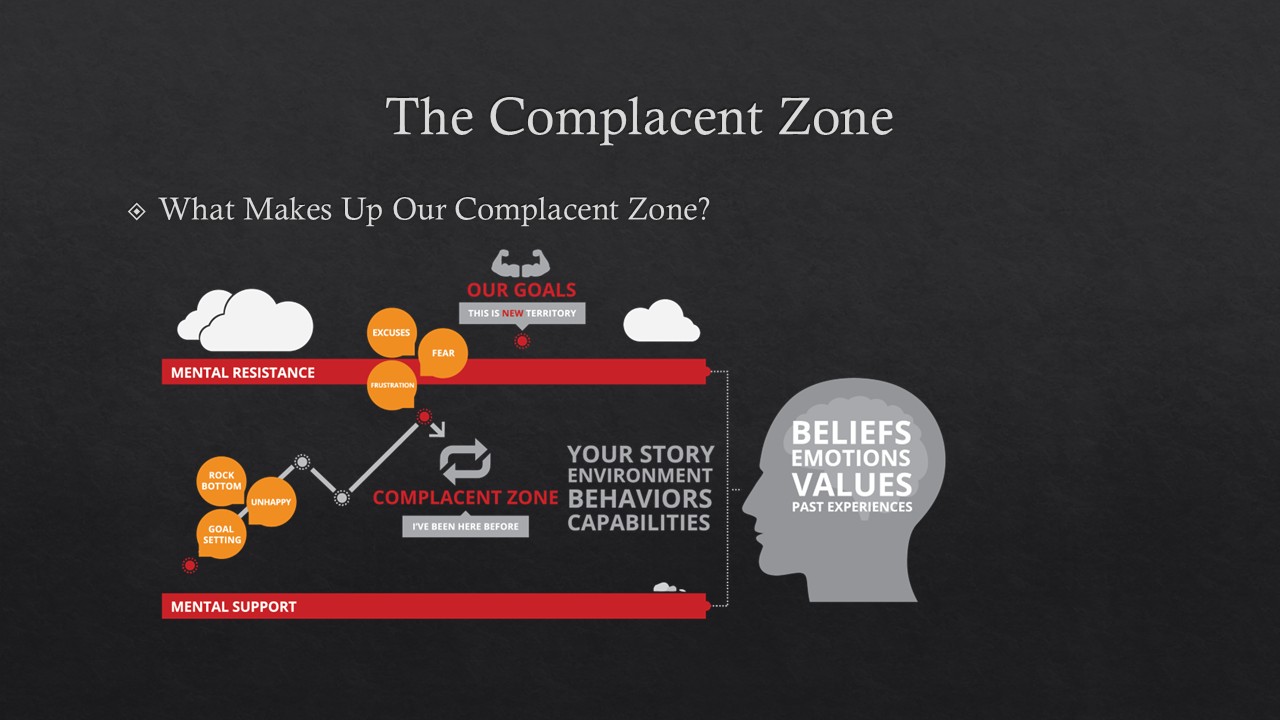
The Complacent Zone is the internal range where existing beliefs, habits, and identity feel psychologically safe, even when they limit future growth. It is not always comfortable in the ordinary sense. People can become familiar with stress, inconsistency, overwork, self-doubt, or repeated disappointment.
When a new behavior pulls someone beyond that familiar range, resistance often appears. The person may overthink the plan, wait for perfect timing, question whether the goal really matters, or return to gathering information. Research becomes attractive because it creates movement without requiring the vulnerability of becoming different.
This helps explain why information doesn’t create change even when the advice is excellent. The obstacle may not be understanding the next step. It may be the Invisible Ceiling created by practiced expectations, emotional conditioning, environmental cues, and an identity that still treats the old level of performance as normal.
Lasting Change Is Built Through Evidence
Personal transformation does not begin when you announce who you intend to become. It begins when your behavior starts producing credible evidence. Each aligned action becomes a small vote for a different identity, a different standard, and a different future response.
One workout does not make someone consistent, and one difficult conversation does not create courageous leadership. But repeated action changes what feels familiar. Over time, the person no longer has to generate the same level of force to behave in alignment because the new response has become increasingly practiced.
This does not mean waiting until you feel like a different person. It means acting with enough awareness and repetition that your internal systems begin adapting to the standard you have chosen. Lasting change is less about performing one heroic act and more about closing the distance between intention and ordinary behavior.
A Human Performance Approach to Change
If you want to understand why information doesn’t create change in a specific area of your life, stop looking only at what you know. Examine the systems influencing whether that knowledge becomes available in action.
Begin with one behavior you already know would improve your performance. Then ask: What happens immediately before I abandon it? What emotion, thought, physical state, environmental cue, or competing demand changes my decision? What identity am I reinforcing through the response I repeatedly practice?
Next, reduce the size of the change until you can repeat it under realistic conditions. The goal is not to prove how hard you can push for three days. The goal is to generate consistent evidence that remains available when motivation falls and pressure rises.
Finally, review leading indicators rather than waiting for lagging results. Track the behaviors, decisions, recovery practices, and emotional responses likely to shape future performance. The scale, revenue report, sleep score, race time, or quarterly result tells you what happened. Your daily patterns help reveal why it happened.
Stop Asking for More Information
The most useful question may not be, “What else do I need to know?” You may already possess enough knowledge to begin. A stronger question is, “Who am I practicing becoming through the decisions I make repeatedly?”
That question turns information into observation and observation into choice. It shifts attention from collecting strategies to identifying the hidden constraints that keep pulling behavior backward. More importantly, it helps you see that change is not something you understand once; it is something you practice until alignment becomes more natural than resistance.
That is ultimately why information doesn’t create change alone. Information can point toward a better path, but lasting change occurs when identity, beliefs, decisions, behavior, emotional regulation, physical readiness, and environment begin supporting the same direction.
Turn What You Know Into the Way You Live
If you are tired of knowing what to do but struggling to follow through consistently, the Resilient Man Framework will help you examine the internal patterns influencing your performance. It is designed to move you beyond temporary motivation and toward greater clarity, alignment, resilience, and sustainable execution.
Use the framework to identify where pressure, identity, recovery, thinking, and behavior have stopped working together. The goal is not to become someone else. It is to remove the hidden constraints preventing you from consistently becoming the man you already know you are capable of being.
Why Information Doesn’t Create Change: Q & A’s
Why doesn’t knowing what to do lead to behavior change?
Knowing provides direction, but behavior is influenced by more than conscious understanding. Identity, emotional responses, stress, physical capacity, habits, environmental cues, and competing priorities all affect execution. When those systems remain aligned with the old pattern, new information has limited leverage. Behavior change becomes more likely when knowledge is translated into small, repeatable actions that generate evidence, reshape expectations, and remain accessible when motivation drops or pressure increases. In other words, knowledge must become practiced capacity before it reliably changes performance.
What role does identity play in lasting change?
Identity influences what feels natural, believable, and consistent with who you believe you are. When a desired behavior supports your self-image and values, it usually requires less internal negotiation. However, identity is not the only factor. Lasting change also depends on emotional regulation, cognitive capacity, recovery, environment, and repeated behavior. Identity Alignment occurs when these systems increasingly support the same goal instead of quietly competing with one another. The objective is coordinated alignment, not trying to solve every performance problem through identity alone.
How can I move from learning to actually changing?
Choose one behavior you already know would improve your performance and observe what interrupts it. Identify the thought, emotion, physical state, environmental trigger, or competing demand that appears before you abandon the action. Then reduce the behavior to a level you can repeat under realistic pressure. Track consistency rather than intensity. Repetition creates credible evidence, and that evidence gradually changes what you expect from yourself and what feels normal. Review your progress weekly and adjust the conditions surrounding the behavior, not merely the goal.
Why do old behaviors return when I’m under pressure?
Pressure reduces the mental and emotional space available for deliberate choice, making familiar responses easier to access. This does not mean pressure makes change impossible; it reveals which behaviors have been practiced deeply enough to remain available when conditions become difficult. Building resilience requires rehearsing the desired response under increasingly realistic conditions while supporting sleep, recovery, emotional regulation, and environmental structure. The goal is to make alignment more accessible, not merely more desirable. What you can access under pressure is a more honest measure than what you intend when calm.
How can coaching help turn information into lasting change?
Coaching helps reveal the gap between what you consciously intend and what your repeated patterns actually support. A skilled coach can identify blind spots, challenge incomplete explanations, clarify the hidden constraints affecting performance, and help convert broad goals into observable behaviors. Coaching also provides feedback and accountability while the new response is still unfamiliar. The value is not simply receiving more advice; it is developing the awareness, alignment, and repetition needed to live what you already know. Effective coaching turns insight into deliberate practice and helps sustain it through real-world pressure.
